We first heard about the 10 feet tall blue aliens long before the movie was released. We waited in anticipation for about a year and our eagerness grew bigger and bigger as the Avatar marketing team was doing its job irreproachably.
Then the blessed hay came when we could rush to the theatres, form queues and feel frustrated when being told that all the seats had been taken. Anyhow, sooner or later we all got the chance to see this revolutionary movie (and those who didn’t, should start doing something about it fast!). And did we like it? Most answers will be “Yes, absolutely!”
We can’t say that the plot had a mind-boggling complexity, but the story was nevertheless original. It is true that many of the movie’s major themes are pretty common in our world today – aliens, environment consciousness, love story between two people belonging to two different worlds etc – but the overall story is both original and exciting. And as others before us have noticed, this is the only billion-dollars movie that is not based on a historic event – like Titanic – or an existing franchise – like The Lord of the Rings, which was a book adaptation, the Pirates of the Caribbean, which is a Disney theme-park adaptation, and others.
And now speaking of billions of dollars, guess whose anxious waiting for the release of the Avatar was the most rewarded? Why James Cameron’s, of course! And he didn’t wait one year for his dream to come true. He wrote the script of the movie in 1994, but back then the technology was not advanced enough for his vision! Only 15 years later all the waiting came to an end and the reward for his patience was way beyond expectations. Avatar, the most expensive movie in history ($500 million!) earned some $2,776,000,000.
So hats off to the biggest movie ever made! Just as important to the movie industry as the first color motion picture film was decades ago, the Avatar is a revolutionary cinematic masterpiece, using state of the art technologies and making a huge impression when viewed in a 3D movie theater.

Saturday, September 17, 2011

The First Space Hotel Will Be Opened in 2016

Yesterday we told you about the dedication of the first spaceport in the world and you probably weren’t surprised to find that it belonged to America. Now we bring to you another huge space tourism piece of news and our guess is that you won’t be surprised to learn that this one comes from Russia.
How does a “Space Hotel” sound? A little Star Trek? Well, in 2016 will sound no less real than Disneyland. This is when Russian company Orbital Technologies plans to launch their bold project into orbit. It will be a small guest house with four rooms capable of accommodating up to seven people. Of course, the conditions are not as impressive as those of Burj Al Arab, but who would dare make a complaint while orbiting the Earth?
The 706 cubic feet house has breathtaking views of the planet and enough amenities to make every guest feel good. Celebrity chefs preparing delicious meals is just one of the special things that we know will await tourists at the hotel.
The price of a stay in the Space Hotel has not been disclosed yet, but we can only expect prohibitive costs. After all, it will be the only luxury space hotel in the world! At least for a few years that is.
The Floating MORP Hotel

What would an alien civilization say of us if they saw a project like this one over here? The MORP Hotel looks so out of this world that you don’t even know what to say when you first look at it. It is a concept by Gianluca Santosuosso that appears to be a living construction.
This is both a hotel and a ship, being able not only to float on water but also to change its shape according to the morphology of the site and even the weather conditions. The MORPHotel is similar in design and movement to the vertebral spine, having “vertebrae” that are linked together by specially designed modules which allow the change in shape of the floating system.
It will not exactly be a cruise ship, even though it will float endlessly from place to place. The hotel will stop for shorter or longer periods time in different countries and the passengers will have the chance to visit important sites and then come back to their temporary home on water. We really want to see this project become reality. And we’re even more anxious to find out what the price of a stay will be!


Avatar 2 and 3 to hit screens in December 2014 and 2015
Director, who is currently working on two screenplays, says some of the profits from his sci-fi sequels will go to green causes
In an interview with Entertainment Weekly at the Producers Guild awards in Los Angeles at the weekend the film-maker said he was currently hard at work on the screenplays for the two features. He revealed that a certain amount of the profits from the series would go to environmental causes.
"I am in the process of writing the next two Avatar films now," said Cameron. "We are planning to shoot them together and post them together, and we will probably release them not quite back to back, but about a year apart. Christmas '14 and '15 is the current plan."
The film-maker has previously hinted that the second film might take place on another planet in the same solar system as Pandora, the fertile forest moon upon which Avatar's action took place. He has also mentioned the possibility of exploring the planet's oceans. Cameron was staying tight-lipped about further details at the weekend but revealed that characters which survived the first film "get to be in the second film, at least in some form".
Of the donation to green causes, the film-maker said: "Fox has partnered with me to donate a chunk of the profits to environmental causes that are at the heart of the Avatar world. I didn't want to make more Avatar movies without a grander plan in place."
Given that the first film made more than $1bn across the globe and stands as the highest-grossing movie of all time, proceeds could be substantial. As yet no announcement has yet been made about how the sequels, which will mark Cameron's first venture into trilogy territory, might be titled.
 | ||
Right behind you ... Avatar's sequel, set for a December 2014 release, will be followed in 2015 by the third film. Photograph: 20th Century Fox/Everett/Rex Features |
"I am in the process of writing the next two Avatar films now," said Cameron. "We are planning to shoot them together and post them together, and we will probably release them not quite back to back, but about a year apart. Christmas '14 and '15 is the current plan."
The film-maker has previously hinted that the second film might take place on another planet in the same solar system as Pandora, the fertile forest moon upon which Avatar's action took place. He has also mentioned the possibility of exploring the planet's oceans. Cameron was staying tight-lipped about further details at the weekend but revealed that characters which survived the first film "get to be in the second film, at least in some form".
Of the donation to green causes, the film-maker said: "Fox has partnered with me to donate a chunk of the profits to environmental causes that are at the heart of the Avatar world. I didn't want to make more Avatar movies without a grander plan in place."
Given that the first film made more than $1bn across the globe and stands as the highest-grossing movie of all time, proceeds could be substantial. As yet no announcement has yet been made about how the sequels, which will mark Cameron's first venture into trilogy territory, might be titled.
Tuesday, May 31, 2011
Avatar 2
Avatar 2 is a planned sequel to the 2009 film Avatar. The film has been mentioned by producer James Cameron, who will also be the director. Cameron has already confirmed the sequel, which will be shot before Battle Angel.
Cameron has said in a statement to THR: "In the second and third films, which will be self contained stories that also fulfill a greater story arc, we will not back off the throttle of Avatar's visual and emotional horsepower, and will continue to explore its themes and characters, which touched the hearts of audiences in all cultures around the world. I'm looking forward to returning to Pandora, a world where our imaginations can run wild."
Cameron has also hinted that the heroes will venture to some of Polyphemus's other moons in the film. He also confirmed that Avatar 2 will explore the Na'vi culture more than Avatar.
On April 20, 2010 Cameron confirmed that Avatar 2 will explore the oceans of Pandora. He also confirmed that Avatar 2 will contain more volcanoes, when prompted by an interviewer. Three days later, it was confirmed that Avatar 2 will take place several years after the events of the original film.
James Cameron also confirmed that the sequels would be filmed back-to-back: “I am in the process of writing the next two ‘Avatar’ films now. We are planning to shoot them together and [edit them in post-production] together, and we will probably release them not quite back to back, but about a year apart.”
In January 2011, James Cameron confirmed that most characters would return for Avatar 2, "Basically, if you survived the first film, you get to be in the second film, at least in some form."
Plot
"I've had a storyline in mind from the start - there are even scenes in Avatar that I kept in because they lead to the sequel," Cameron said. "It just makes sense to think of it as a two or three film arc, in terms of the business plan. The CG plants and trees and creatures and the musculo-skeletal rigging of the main characters - that all takes an enormous amount of time to create. It'd be a waste not to use it again."Cameron has said in a statement to THR: "In the second and third films, which will be self contained stories that also fulfill a greater story arc, we will not back off the throttle of Avatar's visual and emotional horsepower, and will continue to explore its themes and characters, which touched the hearts of audiences in all cultures around the world. I'm looking forward to returning to Pandora, a world where our imaginations can run wild."
Cameron has also hinted that the heroes will venture to some of Polyphemus's other moons in the film. He also confirmed that Avatar 2 will explore the Na'vi culture more than Avatar.
On April 20, 2010 Cameron confirmed that Avatar 2 will explore the oceans of Pandora. He also confirmed that Avatar 2 will contain more volcanoes, when prompted by an interviewer. Three days later, it was confirmed that Avatar 2 will take place several years after the events of the original film.
Production
Before the original film was released, James Cameron talked about turning Avatar into a trilogy of films that would follow for sure Neytiri and later after the film's release Jake as well. Not long after, James Cameron announced that he is in the process of working on the film. The director also went on to say that the film will most likely not be called "Avatar 2", since Jake is no longer an Avatar at the end of the first movie, but rather a Na'vi. He claims that he plans to once again do the impossible by having a much shorter production time, and for the sequel to be much cheaper than the original. Avatar 2 may be shot in a higher frame rate than the original, which is shot at 24 fps. The sequel may be shot at 48 fps, 60 fps or an even higher frame rate.James Cameron also confirmed that the sequels would be filmed back-to-back: “I am in the process of writing the next two ‘Avatar’ films now. We are planning to shoot them together and [edit them in post-production] together, and we will probably release them not quite back to back, but about a year apart.”
Cast
- Sam Worthington as Jake Sully
- Zoe Saldana as Neytiri
- Joel David Moore as Norm Spellman
- Sigourney Weaver as Dr. Grace Augustine
- CCH Pounder as Mo'at
In January 2011, James Cameron confirmed that most characters would return for Avatar 2, "Basically, if you survived the first film, you get to be in the second film, at least in some form."
Wednesday, April 6, 2011
Hell's Gate
 |
| Hell's Gate |
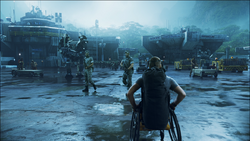
A pentagonal perimeter fence (each side 2.3382 km or 11.69 km--7.264 miles--total) encloses 9.406 sq km (approx. 3.6317 sq miles). Major weapon towers at each apex provide heavy munitions defense against surface and air intrusions by large hostile Pandoran wildlife, while four smaller towers spaced 250 meters apart along each side handle intrusions by smaller life forms, including burrowing attacks. A cleared, thirty-meter-wide strip surrounds the base, which is regularly patrolled by automatic plant-clearing machinery that keeps the jungle at bay through regular administration of acidic mining byproducts. Slightly more than a third of the site is taken up by the shuttle runway, VTOL pads, hangars, equipment storage areas, and garage structures. A similar area is occupied by the armor bay, vehicle storage sheds, and a light industrial plant mainly used for fabricating parts for mining equipment and ammunition for base defense. The unobtanium refinery complex takes up the western side of the facility.
The remainder of Hell's Gate is composed of administrative structures such as: a barracks for SecOps staff, studio-style apartments for technicians and mine workers, an airtight condominium for senior staff, as well as Sci Mod that is part of the utilitdor-connected Hab Mod and Ops Center structures.
Recreational facilities such as the base commissary (popularly known as Hell's Kitchen) are shared, except for an unpressurized section between the research labs and the landing zone mainly used by members of the Avatar Program for athletic training. The recreational facilities are on the fifth floor, along with the gym.
Facilities
 |
| Valkyrie landing in the Airfield |
Airfield
The airfield takes up two thirds of Hell's Gate. The layout features a runway and 2 landing pads connected by a taxiway. The landing Valkyrie flies over the unobtanium mine as it begins its final approach. It is then escorted by Scorpions until it switches its thrusters to vertical and descends to a landing pad. Other landing air vehicles descend to a landing pad and then hover taxi to the hangar area. There is a Control Tower for monitoring air traffic.Armor Bay
The Armor Bay is where vehicles come to get stored, repaired, or refitted. This building is the main storage area of all AMP suits. There is also a small weight room inside a weapons locker that Miles Quaritch uses. Designed for security and rapid force deployment, the Armor Bay is the core of Hell’s Gate’s defenses. Housed inside its large, fortified hanger and at the ready are Dragon Assault Ships configured for battle domination, Scorpion Gunships, Samson Tiltrotors, Heavy Duty Model 10 Slash-Cutters and an array of AMP suits, among other attack craft, support vehicles, and assorted battle-ready machinery.
Avatar Compound
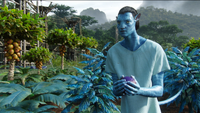 |
| Jake Sully in the Avatar Compound |
Biolab
The Biolab is a small laboratory adjacent to the Operations Center. The amnio tanks containing Jake Sully and Norm Spellman's avatars were unloaded into the room on arrival. The room has several workstations in it for scientific purposes. Jake recorded his first log entry at one of them.Hell's Kitchen
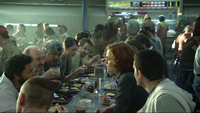 |
| Grace Augustine in Hell's Kitchen |
Operations Center
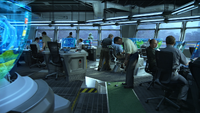 |
| Parker Selfridge practicing his putts in the Operations Center |
Stereolithography Plant
Every piece of human machinery used on Pandora must be made at the Stereolithography Plant. Stereolithography is a form of 3D printing which allows the humans to construct practically anything they want as long as they have raw materials. The limited ability of the plant to construct advanced computers is one of the reasons why the humans were not able to use up-to-date technology in their vehicles. If machinery is in need of an update, the blueprints must be brought on an ISV so the plant has a template for the construction. Another thing that must be brought on a starship is some of the more advanced materials used to make the objects, most raw materials are however collected on Pandora.Vernacular System
 | |
| Diagram showing cross-section of pipes |
The numerous corridors that riddle the base are lined with a series of pipes, which are used for transportation of waste gases, water, electricity and coolant. HVAC pipes (Heating, Ventilation and Air Conditioning) run at floor level, which are brought up via vertical feeds and diffused into the rooms from above.
Avatar Program
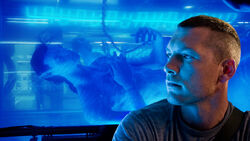 |
| Jake Sully in the Avatar Program |
Origins
Under strong pressure from the UN, scientists and the general public, the RDA agreed to set up a program to enhance communications between humans and Na’vi. At first, this consisted solely of an Indigenous Terrain program to study Na’vi culture and language and to attempt to establish communication between human and Na'vi.Practical difficulties soon showed a need for a more profound means of communication between the human and Na’vi species.
Invention / Technology
RDA research had already established the possibility of direct mental communication between humans. RDA scientist Dr. Cordell Lovecraft was given the task of carrying his Dark Dreamer project, which sought to transmit mental processes – “thoughts” – to humans at a distance, as well as interspecies mental communication.Initial dissection of Na’vi specimens found that although the Na’vi show a surprising degree of external parallel evolution, their internal anatomy and metabolic processes were substantially different from that of humans. The Na’vi brain in particular, with its external neural queue and three-lobed cerebral structure, proved a daunting obstacle.
Building on work with brain-wiped primates and condemned criminals, Dr. Lovecraft was able to demonstrate that full sensory bonding could be established between human twins, human-animal hybrids that shared common DeoxyriboNucleic Acid (DNA), and eventually human/Na’vi hybrids with "resonant" genetic DNA/NVTranscriptase blueprints.
Since the Na’vi cellular nucleus organelle does not use nucleic acids (DNA or RNA) to encode genetic information, producing a ‘translation table’ that matched a specific human's DNA to a Na'vi NVTranscriptase equivalent closely enough to allow a level of neural resonance strong enough for congruent mental communication to occur required many months of processing on massively parallel "zettaflop" photonic computing arrays as well as many failed experiments; some of which caused severe permanent psychological trauma to volunteer subjects.
Eventually the Avatar Program succeeded in producing the first viable hybrids between completely unrelated species – a considerable achievement since, as Dr Lovecraft famously remarked, humans are “far more closely related genetically to garden slugs than to Na’vi.”
With the aid of thought amplification/transmission "link beds" as well as customized nanotech receiver/transmitter nodes grown into avatar brains from their earliest blastomere stage of development, human "drivers" can now operate their avatars at distances of tens of kilometers. These distances can be reduced in areas where the Pandoran magnetic fields are very strong, such as near the many flux vortices.
Originally part of RDA’s Na’vi outreach program instigated at the behest of Earth's government authorities, the Avatar Program has moved from being a poorly-defined xenobiological experiment controlled by Earth-based bureaucrats, ivory-tower academics, and populist politicians to become a tightly-managed engineering project incorporating the most advanced technology from RDA’s research and development laboratories.
Dr. Lovecraft has been nominated for multiple Nobel Prizes in biological sciences, but the nominations have invariably been withdrawn following protests from human rights organizations, the UN Pan-Faith Council, and animal rights activists.
Avatar Creation
The Avatar program combines genetic information from the native race of Pandoran humanoids, the Na'vi, with human DNA from a selected human operator or controller, also known as a 'driver'.Avatar drivers are selected on Earth from volunteer pools using incredibly stringent selection criteria, requiring high motor coordination skills, mental acuity and resistance to mental fatigue. The operators are physically screened and genome sequenced, and a number of tissue, blood and cell samples are taken. Overall, 99% of the trainee intake fail the initial testing. The successful creation of an avatar/operator pair is an extremely expensive process - costing upwards of 20 million dollars for each successful avatar build.
Once a suitable operator is found, avatar creation begins in earnest. RDA genetics labs create a hybrid embryo, which is a fused genetic product of the Na'vi and human operator DNA donors. Creating a viable embryo is the most complex part of the process and is prone to failure since the alien Na'vi genome is significantly different to human DNA. The composite eliminates defects, reduces the influence of individual Na'vi appearance traits and boosts compatibility with the human donor DNA sample.
From the hundreds grown specifically for each operator, many die before reaching the fifty-cell stage. However, some high-quality embryos survive into early organogenesis.
Avatar Control Link
An avatar driver uses a whole body remote neural interface to control and animate the avatar body. These link units are located in a dedicated facility, such as that installed at the Hell's Gate base on Pandora. The link beds outwardly resemble MRI scanners, with the operator reclining inside an enclosed capsule. The capsule incorporates neural collection and feedback loops for control transmission and reception of sensory information from the avatar body.The link capsule also continuously monitors operator vital signs and avatar operational parameters. In the event of an abnormality, the link is discontinued immediately, or referred to a Biolab technician for further analysis.
To initiate the link, the operator clears his or her mind and enters a transit state of consciousness while the link is established. Once operator-avatar connection quality stabilizes above 99%, the link is set to active; the operator then immediately 'wakes up' inside the avatar body. The operator's own neurotransmitters then cause atonia, disconnecting the operator's natural body from the movements played out by their avatar. Continuous link times vary by individual operator; a new operator may tire and prematurely disconnect from the avatar after only a few minutes, while an experienced driver is capable of several hours or even days link time. Upon disconnection, either by emergency fail-safe or the operator's conscious command, the avatar reverts to a static sleep state, while the operator consciousness is awakened safely in his/her own body. Disorientation is common upon return, although experience reduces downtime. Emergency disconnections are dangerous, potentially resulting in shock to the human operator, and damage to the avatar itself. Catastrophic damage to the avatar (resulting in its biological death) has the same effect.
Avatar operations are limited by the need for the human operator to sleep, rest, and eat. Similarly, the avatar body must also be maintained through sleep/disconnection time and consumption of fluids and foodstuffs.
The link machinery is small enough to allow for field operation where link transmission range may become an issue. Compact field bases feature a bank of three ruggedized link beds. Basic science/accommodation facilities are included with embedded power and air filtration, making them fully self sufficient for short sorties into the Pandoran jungle. The field base can be air-lifted using a Samson air transport to reach remote locations. Although occasionally prone to 'glitches', transmission strength is strong enough to ensure link integrity even in extreme environments such as the flux vortices found in the Hallelujah Mountains of Pandora.
Avatar Field Operations on Pandora
The Avatar Program is headed by Dr. René Harper, as part of RDA research. While Dr. Grace Augustine uses her avatar form to teach rudimentary English to some of the Na'vi, Colonel Quaritch prefers to use them to gain the Na'vi's trust and find out means to make them move from Hometree, as seen from his deal with Jake Sully.- Human - Na'vi Relations
- contact, communication, cultural exchange
- education (human languages, culture, and etiquette)
- Reconnaissance
- primarily military information gathering
- Exploration
- sample collection, flora and fauna studies
- Construction
- commissioning and dismantling field bases and structures
Subscribe to:
Posts (Atom)